I've recently begun writing a blog for the Register-Star Newspaper, which will be including a number of reviews of art. Please take a look at my first piece. It's a review of an new installation by Hudson, NY artist Laetitia Hussain at Terenchin Fine Arts in Catskill, NY.
Man and Nature: Aurum, an installation by Laetitia Hussain.
For thousands of years humanity has toiled to mold nature to its own ends, removing that which doesn’t suit its purposes and manipulating that which does. Aurum, a new installation by Hudson artist Laetitia Hussain, at Terenchin Fine Art in Catskill, uses cast-off items, both natural and man-made to talk about the relationship between humanity and nature in its positive and negative aspects.
The gallery, located at 462 Main St., is filled to overflowing with Hussain’s work, mainly sculptures and most covered in gold paint, thus the name of the show “Aurum,” which is Latin for gold. While the work’s gilding helps to integrate the pieces internally and as a whole, they suffer from a loss of the individual color characteristics of the materials used.
The work also suffered from overcrowding. Less is sometimes more and many of the larger pieces lost their impact by being too close to each other in the gallery.
Her wood slice dartboards, while a bit facile, efficiently hammer in the metaphorical aspect of the show. The act of throwing a dart—which the artist encourages—at a beautiful piece of wood, marring the surface, helps force the viewer into an understanding of how humans often affect nature.
Another interesting piece is a tree branch mounted on wood to resemble trophy antlers. It forces the viewer to go beyond thinking only of the animal world and to contemplate humanity’s attitude towards the rest of nature.
The largest piece—and probably the best—incorporates the root system of a tree with various implements associated with farming—pickaxe and pitchfork—affixed to the roots’ ends, while the carved wooden handles of scythes rise out of the top. It plays with this relationship as well but takes it further by the interplay of materials that echo one another. A small reflecting pool below the tree trunk works to expand and reflect the hanging portion of the piece above and gives it a meditative quality that works nicely with the rather wild, dynamic aspect of the tree.
A sculpture of a windmill juxtaposed next to a small wooden piece hanging on the wall, carved to resemble a farmer’s field with crop rows, uses both scale and space to give the viewer a sense of being outside the gallery and while not as intellectually bracing as some of the other pieces is none the less completely engaging.
Hussein includes a large-scale photographic piece in the show featuring a quote by 18th century painter, printmaker and poet William Blake. The words are formed in the large photograph by maple seeds and seems to capture Hussain’s intentions. “The tree which moves some to tears of joy is in the eyes of others only a green thing that stands in the way,” it reads in part. Her new show goes far in visually exploring those words and the thoughts behind them.
Click here to view images from the show.
Wednesday, July 29, 2009


Thursday, July 16, 2009
The Classic Cad: The World of Tony Stamolis
Photographer Tony Stamolis, whose work has appeared everywhere from the New York Times to London art galleries, has been called a “classic cad” with a “prankster’s eye,” among other sobriquets and was recently included in Taschen’s coffee table tome “The New Erotic Photography.” Look, Read, Listen recently caught up with the 38-year-old California born artist who has made his home in New York City for almost half his life.
How and when did you get started in photography? Have you always been interested in photographing the nude?
I have always taken pictures but it wasn't until I had my first show in 1999 that I saw that my photography communicated to others. That's when I started taking it seriously and looking at it differently. I assisted a friend for a while and went on my own in 2003. The nude thing just sort of happened. I took some of my first serious girlfriend in my grandmother's basement bedroom when I was 18. Of course, my wise old grandmother knew I had had a girl down there and I got a talking to. She probably would have disowned me if she had know about the pictures. Sorry Yia-yia!
Your work has been included in Taschen’s “The New Erotic Photography.” How would you define this genre and your role within it?
Like I said in that book, I hate the term erotic, and typically hate anything associated with the genre. Most things that try to be sexy, are quite the opposite. I take photos of women (and this doesn't always mean sans clothing) because I like to and apparently, I am good at it. I don't want to be dubbed an erotic photographer. That's too limiting. I consider my nude work to be portraits as well.
What separates pornography from erotic art? Is it intention or something more ill-defined?
I think it's the thought behind it, and the perception of the eye of the beholder. Porn has become a form of pop art. It's more accepted and mainstream now and is very influential to so many areas of our daily lives and culture. Maybe penetration is the line people need to differentiate.
Color seems to play a huge part in your work. Have you always been drawn to that aspect of photography?
I have used B&W before, but yes, I have always been attracted to juicy, saturated color.
Do you use digital or traditional cameras or both? Which do you prefer and why?
More and more digital, the better it looks, but I still love film. The immediacy of digital is a big draw. I am not a snob though. Whatever is in front of me, I use. My photography is super lo-fi.
Your book “Frezno”(which came out last year) has a sense of immediacy and intimacy. Since you grew up in Fresno did the subject matter come easily to you? What were you striving for? How long did the project take?
I shot a few days a year for six years when I was home visiting my mother. The place definitely defines who I am and how I look at things, so I guess it came easily in that sense. I did work for it though. I didn't know any people there anymore, and shot almost a hundred portraits in three days on one trip. A project like that never feels finished, but I wanted to tell a story with what I had up to that point.
How did your project “Narcissister” come about? It seems like there is a relationship there to the work of Paul McCarthy and Hans Bellmer. Who are some of the artists who’ve influenced you?
All of that is the genius work of a friend who has fused her art work with burlesque. She's an ex-Ailey dancer who I met at Louise Bourgeois' monthly artist "salon" years ago. I have photographed many of her projects but really fell in love with her Narcissister "alter-ego." She's always creating new pieces so this is ongoing.
I love that you compared this to Bellmer and McCarthy. I love both of their work. Nobuyoshi Araki and Nan Goldin are major influences and to repeat myself again, old album art and vintage smut. Always inspiring.
Where do the ideas for your projects come from?
These are just silly ideas that I latch onto, and run with.
What are you working on now?
I have just finished my second book that will be out this Fall...it's a secret!
But I can tell you that it has a whole bunch of nekkid women in it.
How and when did you get started in photography? Have you always been interested in photographing the nude?
I have always taken pictures but it wasn't until I had my first show in 1999 that I saw that my photography communicated to others. That's when I started taking it seriously and looking at it differently. I assisted a friend for a while and went on my own in 2003. The nude thing just sort of happened. I took some of my first serious girlfriend in my grandmother's basement bedroom when I was 18. Of course, my wise old grandmother knew I had had a girl down there and I got a talking to. She probably would have disowned me if she had know about the pictures. Sorry Yia-yia!
Your work has been included in Taschen’s “The New Erotic Photography.” How would you define this genre and your role within it?
Like I said in that book, I hate the term erotic, and typically hate anything associated with the genre. Most things that try to be sexy, are quite the opposite. I take photos of women (and this doesn't always mean sans clothing) because I like to and apparently, I am good at it. I don't want to be dubbed an erotic photographer. That's too limiting. I consider my nude work to be portraits as well.
What separates pornography from erotic art? Is it intention or something more ill-defined?
I think it's the thought behind it, and the perception of the eye of the beholder. Porn has become a form of pop art. It's more accepted and mainstream now and is very influential to so many areas of our daily lives and culture. Maybe penetration is the line people need to differentiate.
Color seems to play a huge part in your work. Have you always been drawn to that aspect of photography?
I have used B&W before, but yes, I have always been attracted to juicy, saturated color.
Do you use digital or traditional cameras or both? Which do you prefer and why?
More and more digital, the better it looks, but I still love film. The immediacy of digital is a big draw. I am not a snob though. Whatever is in front of me, I use. My photography is super lo-fi.
Your book “Frezno”(which came out last year) has a sense of immediacy and intimacy. Since you grew up in Fresno did the subject matter come easily to you? What were you striving for? How long did the project take?
I shot a few days a year for six years when I was home visiting my mother. The place definitely defines who I am and how I look at things, so I guess it came easily in that sense. I did work for it though. I didn't know any people there anymore, and shot almost a hundred portraits in three days on one trip. A project like that never feels finished, but I wanted to tell a story with what I had up to that point.
How did your project “Narcissister” come about? It seems like there is a relationship there to the work of Paul McCarthy and Hans Bellmer. Who are some of the artists who’ve influenced you?
All of that is the genius work of a friend who has fused her art work with burlesque. She's an ex-Ailey dancer who I met at Louise Bourgeois' monthly artist "salon" years ago. I have photographed many of her projects but really fell in love with her Narcissister "alter-ego." She's always creating new pieces so this is ongoing.
I love that you compared this to Bellmer and McCarthy. I love both of their work. Nobuyoshi Araki and Nan Goldin are major influences and to repeat myself again, old album art and vintage smut. Always inspiring.
Where do the ideas for your projects come from?
These are just silly ideas that I latch onto, and run with.
What are you working on now?
I have just finished my second book that will be out this Fall...it's a secret!
But I can tell you that it has a whole bunch of nekkid women in it.
Thursday, July 9, 2009
History through the private lens: An interview with Benjamin Patton
Benjamin Patton spends many of his days sorting through the memories of others, putting the pieces together and rediscovering history through personal reminiscences, both for himself and the men and women he makes films about. But then he’s had a lot of experience with history through a personal lens. He’s the grandson of one of America’s most famous warriors, Gen. George S. Patton, and the son of Major General George Smith Patton, both of whom kept personal histories. Benjamin Patton took time to answer some questions for Look, Read, Listen.
History seems to have been important to your family, both in the private and public spheres, from your grandfather and father’s collecting their own letters and papers to your family touring historical sites. Has this influenced your view of history? Can personal history help to explain the larger
picture of the past?
I think it's incredibly valuable and enriching to be able to experience history through those that lived it. Whether it means reading someone's diaries and letters - such as The Patton Papers (Vol I & II) in the case of my grandfather, or being able to read a copy of Rudyard Kipling's Complete Book of Verse that has been annotated with all sorts of margin notes by both my father and grandfather. History through the lens of another person sort of brings you there to that moment; not only in history, but the moment THEY experienced that history. We visited more than a few battlefields as a family when I was a teen - from Gettysburg and Chancellorsville to Zama (where Scipio Africanus bested Hannibal) and Austerlitz -- This all has left an impression on me that is much harder to shake or forget than simply reading a text book.
As a producer and filmmaker why have you chosen to focus on peoples’ personal histories as opposed to exploring history in other ways?
Again, I feel that experiencing history through the conduit of someone who as there brings it alive in a special way. This is even more important when you are chronicling your own family's history and say, want to understand the great depression more viscerally and personally through your grandmother or great aunt or uncle who lived through it.
You come from a long line of distinguished military men. Why did you choose to follow a different path and was there a defining moment for you when you decided against a military career?
For most of my childhood I was set on becoming a naval officer. Just loved the ocean and sailing and maritime history and that was my focus. But that career plan was made in the context of military being the family business. The pressure to serve in the military wasn't overt, my father was content with any career that would fulfill me - but he, like me at the time, felt this would be something I could excel at. Perhaps the first of many defining moments came when I opted not to attend the Naval Academy Prep School in Newport - an Annapolis feeder program that I had been accepted to. There were many more such moments to come throughout my twenties as I opted not to pursue a military career each time I reached a juncture in my life where I would henceforth lose an options - USNA > ROTC > OCS, etc. In the end, I have come to peace with that decision because I have found another - perhaps even more effective - way for me to express my patriotism while also working in my gifts and following my bliss.
Has being a Patton helped or hindered your career?
Both. Sometimes it's a hindrance, sometimes an advantage -- depending on my age and level of self-confidence and centeredness. As a young adult, it helped to open doors, but when you walk through those doors you'd better know who you are -- and I didn't. Today, I have the family in proper perspective and because I don't depend on it to further my career, it's probably a benefit. The greatest joy of being in this family is being able to help an old veteran reconnect with his own military and combat service by serving as a conduit for them to my father or grandfathers (both of whom were generals also).
Do you feel that the relationship that your grandfather had with your father influenced his parenting style with you and your siblings? How?
Certainly, and I made this point in my June '09 Smithsonian article. My father and grandfather had a good relationship but when my father when away to boarding school at 13, their relationship occurred more at a distance. Keep in mind that my father only saw his father during his leave.
What was it like interviewing Manfred Rommel (the son of German General Erwin Rommel)? I assume you knew him since your father and he were friends. If so did that help in the interview process? What, for you, was the most interesting aspect of your interview?
Certainly interviewing Manfred Rommel was fascinating. I had known since I was about 9 years old - when we lived in Stuttgart, Germany. My dad and he had met in the 50s when my dad was stationed in Stuttgart for the first time. My grandfather had always wanted to meet Field Marshall Rommel - but since Rommel was forced to take poison by Hitler in late '44 and GEN Patton died in late '45, they never met. Once my dad and Manfred met, they quickly bonded and soon, when they realized they shared a birthday of Christmas Eve, we would celebrate it with them whenever we lived in Germany. They would trade memorabilia of their father's - maps, keepsakes, etc. as gifts. It was quite a thing.
How does the editing process come into play in your work? Is it difficult to know what to keep and what to throw away? At the end of the day is it the story line that counts or the accumulation of historical information or is there a happy medium?
The process is partly intentional and partly not. That is to say, when a project first comes my way, I have to determine what the center point of the film is - and how does the family want to organize the film - chronologically, or perhaps more creatively say, according to theme. One film I did about a retired General was organized into five areas: family, education, service, faith and integrity. But beyond that initial organization - which is largely client-driven, you simply go where the story is. I typically proceed as though the film is a block of marble, within which the final story lies. The trick is knowing how and which pieces to chip away and discard (on the editing floor) so that you are left with the essence of someone's story. And while there is of course more than one possible final film, I always proceed as if there is only one possible outcome - we just don't know what it is until it reveals itself to everyone and then Voila! It's a fascinating process.
Your company donates five percent of its earnings to various civic organizations. Why do you feel it’s important to give back to the community?
When I was growing up, we were always having to remember quotes 'to live by,' as it were. One that was often told to us was, "He to whom much hath been given, much shall be required." I'm pretty certain it's from the Bible, though I can't recall the exact reference. But it's so true. I was born with a great deal of opportunities that many people just don't ever have. The key is not to waste it - and (another quote), "Leave the world better than you found it."
You are the co-founder of Fred’s teen workshops. Do you feel it’s important to give the next generation a voice and if so why?
Today’s kids live in a video world. Few activities dominate their lives like the time spent watching movies, television or playing video games. This has left many young people with a sophisticated understanding of images but without the critical skills to process these images contextually. At Fred's Experimental Media, our mission is to flip the switch from passive image consumption to active and thoughtful image creation. Educational engagement and connection are understood to be critical aspects of today’s educational experience. With drop-out rates alarmingly high, schools, as well as community and therapeutic organizations, are all looking to deeply engage teens and provide opportunities for deep reflection on self and community. We do our best to make this possible for kids on as broad a spectrum as possible -- and though we are small -- Guess what? It's working.
What are you working on now?
I'm working on several projects right now - 3 or 4 new video biography projects have come to me as a result of my recent Smithsonian article and subsequent interview on NPR Weekend Edition (on Father's Day.) So that's taking up a lot of my time. We have also just finished a teen film workshop for FRED in Denver and start the fourth year of our MA teen film workshop for 35 teenagers next week. Beyond that, I am father to a baby boy - born exactly one month ago. His name is Tiger and he is a happy handful.
History seems to have been important to your family, both in the private and public spheres, from your grandfather and father’s collecting their own letters and papers to your family touring historical sites. Has this influenced your view of history? Can personal history help to explain the larger
picture of the past?
I think it's incredibly valuable and enriching to be able to experience history through those that lived it. Whether it means reading someone's diaries and letters - such as The Patton Papers (Vol I & II) in the case of my grandfather, or being able to read a copy of Rudyard Kipling's Complete Book of Verse that has been annotated with all sorts of margin notes by both my father and grandfather. History through the lens of another person sort of brings you there to that moment; not only in history, but the moment THEY experienced that history. We visited more than a few battlefields as a family when I was a teen - from Gettysburg and Chancellorsville to Zama (where Scipio Africanus bested Hannibal) and Austerlitz -- This all has left an impression on me that is much harder to shake or forget than simply reading a text book.
As a producer and filmmaker why have you chosen to focus on peoples’ personal histories as opposed to exploring history in other ways?
Again, I feel that experiencing history through the conduit of someone who as there brings it alive in a special way. This is even more important when you are chronicling your own family's history and say, want to understand the great depression more viscerally and personally through your grandmother or great aunt or uncle who lived through it.
You come from a long line of distinguished military men. Why did you choose to follow a different path and was there a defining moment for you when you decided against a military career?
For most of my childhood I was set on becoming a naval officer. Just loved the ocean and sailing and maritime history and that was my focus. But that career plan was made in the context of military being the family business. The pressure to serve in the military wasn't overt, my father was content with any career that would fulfill me - but he, like me at the time, felt this would be something I could excel at. Perhaps the first of many defining moments came when I opted not to attend the Naval Academy Prep School in Newport - an Annapolis feeder program that I had been accepted to. There were many more such moments to come throughout my twenties as I opted not to pursue a military career each time I reached a juncture in my life where I would henceforth lose an options - USNA > ROTC > OCS, etc. In the end, I have come to peace with that decision because I have found another - perhaps even more effective - way for me to express my patriotism while also working in my gifts and following my bliss.
Has being a Patton helped or hindered your career?
Both. Sometimes it's a hindrance, sometimes an advantage -- depending on my age and level of self-confidence and centeredness. As a young adult, it helped to open doors, but when you walk through those doors you'd better know who you are -- and I didn't. Today, I have the family in proper perspective and because I don't depend on it to further my career, it's probably a benefit. The greatest joy of being in this family is being able to help an old veteran reconnect with his own military and combat service by serving as a conduit for them to my father or grandfathers (both of whom were generals also).
Do you feel that the relationship that your grandfather had with your father influenced his parenting style with you and your siblings? How?
Certainly, and I made this point in my June '09 Smithsonian article. My father and grandfather had a good relationship but when my father when away to boarding school at 13, their relationship occurred more at a distance. Keep in mind that my father only saw his father during his leave.
What was it like interviewing Manfred Rommel (the son of German General Erwin Rommel)? I assume you knew him since your father and he were friends. If so did that help in the interview process? What, for you, was the most interesting aspect of your interview?
Certainly interviewing Manfred Rommel was fascinating. I had known since I was about 9 years old - when we lived in Stuttgart, Germany. My dad and he had met in the 50s when my dad was stationed in Stuttgart for the first time. My grandfather had always wanted to meet Field Marshall Rommel - but since Rommel was forced to take poison by Hitler in late '44 and GEN Patton died in late '45, they never met. Once my dad and Manfred met, they quickly bonded and soon, when they realized they shared a birthday of Christmas Eve, we would celebrate it with them whenever we lived in Germany. They would trade memorabilia of their father's - maps, keepsakes, etc. as gifts. It was quite a thing.
How does the editing process come into play in your work? Is it difficult to know what to keep and what to throw away? At the end of the day is it the story line that counts or the accumulation of historical information or is there a happy medium?
The process is partly intentional and partly not. That is to say, when a project first comes my way, I have to determine what the center point of the film is - and how does the family want to organize the film - chronologically, or perhaps more creatively say, according to theme. One film I did about a retired General was organized into five areas: family, education, service, faith and integrity. But beyond that initial organization - which is largely client-driven, you simply go where the story is. I typically proceed as though the film is a block of marble, within which the final story lies. The trick is knowing how and which pieces to chip away and discard (on the editing floor) so that you are left with the essence of someone's story. And while there is of course more than one possible final film, I always proceed as if there is only one possible outcome - we just don't know what it is until it reveals itself to everyone and then Voila! It's a fascinating process.
Your company donates five percent of its earnings to various civic organizations. Why do you feel it’s important to give back to the community?
When I was growing up, we were always having to remember quotes 'to live by,' as it were. One that was often told to us was, "He to whom much hath been given, much shall be required." I'm pretty certain it's from the Bible, though I can't recall the exact reference. But it's so true. I was born with a great deal of opportunities that many people just don't ever have. The key is not to waste it - and (another quote), "Leave the world better than you found it."
You are the co-founder of Fred’s teen workshops. Do you feel it’s important to give the next generation a voice and if so why?
Today’s kids live in a video world. Few activities dominate their lives like the time spent watching movies, television or playing video games. This has left many young people with a sophisticated understanding of images but without the critical skills to process these images contextually. At Fred's Experimental Media, our mission is to flip the switch from passive image consumption to active and thoughtful image creation. Educational engagement and connection are understood to be critical aspects of today’s educational experience. With drop-out rates alarmingly high, schools, as well as community and therapeutic organizations, are all looking to deeply engage teens and provide opportunities for deep reflection on self and community. We do our best to make this possible for kids on as broad a spectrum as possible -- and though we are small -- Guess what? It's working.
What are you working on now?
I'm working on several projects right now - 3 or 4 new video biography projects have come to me as a result of my recent Smithsonian article and subsequent interview on NPR Weekend Edition (on Father's Day.) So that's taking up a lot of my time. We have also just finished a teen film workshop for FRED in Denver and start the fourth year of our MA teen film workshop for 35 teenagers next week. Beyond that, I am father to a baby boy - born exactly one month ago. His name is Tiger and he is a happy handful.
Sunday, June 7, 2009
Addendum to "A Conversation with Josh Sternfeld"
"Meskada" writer-director Josh Sternfeld just confirmed that actors Nick Stahl and Rachel Nichols would be playing the leads in his rural police drama set to begin filming Monday in Greene and Columbia Counties in New York's Hudson Valley.
He said that the contracts were signed and that the other roles would be filled in quickly as they head into production.
Stahl will be playing Noah Cordin, a small town police detective investigating the homicide of a young child that occurs during a break-in.
Stahl is probably best known from his role as John Connor in “Terminator 3: Rise of the Machines” and from HBO’s series “Carnivale” and the 2001 film “In the Bedroom.”
Nichols will be playing Leslie Spencer, a county Sheriff’s Investigator, also working on the homicide case.
She can currently be seen in “Star Trek” and is also starring in the upcoming film ”GI Joe: The Rise of Cobra” set to be released in August.
“I’m very excited to be working with both actors,” Sternfeld told Look, Read, Listen.
He said that the contracts were signed and that the other roles would be filled in quickly as they head into production.
Stahl will be playing Noah Cordin, a small town police detective investigating the homicide of a young child that occurs during a break-in.
Stahl is probably best known from his role as John Connor in “Terminator 3: Rise of the Machines” and from HBO’s series “Carnivale” and the 2001 film “In the Bedroom.”
Nichols will be playing Leslie Spencer, a county Sheriff’s Investigator, also working on the homicide case.
She can currently be seen in “Star Trek” and is also starring in the upcoming film ”GI Joe: The Rise of Cobra” set to be released in August.
“I’m very excited to be working with both actors,” Sternfeld told Look, Read, Listen.
Thursday, May 14, 2009
A Conversation with Josh Sternfeld
Josh Sternfeld, a New York writer and filmmaker, is currently in pre-production for his second feature film, Meskada, a rural police drama that pits two towns, one struggling, the other well-off, against each other over the death of a child.
Sternfeld has two short films, “Balloons, Streamers” from 1997 and 1999’s “Colin’s Date” under his belt as well as one feature, “Winter Solstice” (2005), which starred Anthony LaPaglia, Aaron Stanford, Allison Janney, Mark Weber and Michelle Monaghan.
Sternfeld was also part of the prestigious Sundance writers workshop.
He took some time out to answer a few questions for Look, Read, Listen.
Your first three films are set in a suburban environment, why did you choose to delve into the rural world for your newest film?
I felt ready to approach a new environment, one that didn't come from my own upbringing. I was excited for the screenwriting challenge that comes from having to do real research, talking and learning from people whose experience of life was different from my own.
You have thus far mined the territory of the quiet family drama, where the plot is driven by character and circumstance rather than by grand action, so how did you translate this into the script for your newest film Meskada? Was it hard to balance the action with the more subtle aspects of character and place?
Balancing the action/ "plot-driven” elements of the story with the more subtle character work was a real challenge; it took many drafts over a couple years (and definitely many missteps) to get to the finished screenplay. More often than not, it meant doing the action and plot work first, then finding ways to bring in character traits and relationships to the scenes.
If I remember correctly you were a fan of 1981’s Ordinary People, what other films and/or filmmakers have inspired you and why?
My filmmaking influences and heroes are pretty diverse. I'm a huge admirer of Stanley Kubrick, mainly because he brought a singular and personal approach to such a wide array of genres. It takes incredible discipline and focus to work that way - something I hope to do someday. I'm also a big fan of Martin Scorsese (like every other director!)...for his boldness, the passion and energy he brings to the screen. Paul Thomas Anderson is another filmmaker I think is pretty fantastic.
What is it about the inner tensions of families that you seem drawn to exploring?
Well, to be honest, I think there's a universal draw to those themes. However, I hope with "Meskada" and in the future, that I'm changing my approach in exploring those tensions - the idea of the "quiet family drama" is not very exciting to me anymore. I would like to continue dramatizing family tensions, but in more provocative stories.
Your first full-length film “Winter Solstice” premiered at the Tribeca Film Festival and garnered favorable reviews. Having tasted some success, has there been an emotional struggle to get your next film into production because of this?
Well, it's has been a longer and more difficult struggle than I would have anticipated four years ago. That being said, I think everyone in the arts would agree that it's a long road, with lots of twists and turns...
Your next project is being made on a shoestring budget, do you feel you will be able to tell the story you intended without the major funding and do you feel that perhaps the struggle could enhance the final product?
For sure, I agree that the budget and spirit of this could make it a better film. Having to be creative and resourceful when you don't have tons of money can be a great thing...but then again, ask me in two months!...
How is pre-production for Meskada going? Who have you lined up as far as actors go and how did the process of casting occur? Did you have anyone in mind for specific roles?
Pre-production is going great; very busy with the locations search, and all the casting decisions. I don't usually write with specific actors in mind...which I guess makes the casting process kind of fun and unpredictable...
Sternfeld has two short films, “Balloons, Streamers” from 1997 and 1999’s “Colin’s Date” under his belt as well as one feature, “Winter Solstice” (2005), which starred Anthony LaPaglia, Aaron Stanford, Allison Janney, Mark Weber and Michelle Monaghan.
Sternfeld was also part of the prestigious Sundance writers workshop.
He took some time out to answer a few questions for Look, Read, Listen.
Your first three films are set in a suburban environment, why did you choose to delve into the rural world for your newest film?
I felt ready to approach a new environment, one that didn't come from my own upbringing. I was excited for the screenwriting challenge that comes from having to do real research, talking and learning from people whose experience of life was different from my own.
You have thus far mined the territory of the quiet family drama, where the plot is driven by character and circumstance rather than by grand action, so how did you translate this into the script for your newest film Meskada? Was it hard to balance the action with the more subtle aspects of character and place?
Balancing the action/ "plot-driven” elements of the story with the more subtle character work was a real challenge; it took many drafts over a couple years (and definitely many missteps) to get to the finished screenplay. More often than not, it meant doing the action and plot work first, then finding ways to bring in character traits and relationships to the scenes.
If I remember correctly you were a fan of 1981’s Ordinary People, what other films and/or filmmakers have inspired you and why?
My filmmaking influences and heroes are pretty diverse. I'm a huge admirer of Stanley Kubrick, mainly because he brought a singular and personal approach to such a wide array of genres. It takes incredible discipline and focus to work that way - something I hope to do someday. I'm also a big fan of Martin Scorsese (like every other director!)...for his boldness, the passion and energy he brings to the screen. Paul Thomas Anderson is another filmmaker I think is pretty fantastic.
What is it about the inner tensions of families that you seem drawn to exploring?
Well, to be honest, I think there's a universal draw to those themes. However, I hope with "Meskada" and in the future, that I'm changing my approach in exploring those tensions - the idea of the "quiet family drama" is not very exciting to me anymore. I would like to continue dramatizing family tensions, but in more provocative stories.
Your first full-length film “Winter Solstice” premiered at the Tribeca Film Festival and garnered favorable reviews. Having tasted some success, has there been an emotional struggle to get your next film into production because of this?
Well, it's has been a longer and more difficult struggle than I would have anticipated four years ago. That being said, I think everyone in the arts would agree that it's a long road, with lots of twists and turns...
Your next project is being made on a shoestring budget, do you feel you will be able to tell the story you intended without the major funding and do you feel that perhaps the struggle could enhance the final product?
For sure, I agree that the budget and spirit of this could make it a better film. Having to be creative and resourceful when you don't have tons of money can be a great thing...but then again, ask me in two months!...
How is pre-production for Meskada going? Who have you lined up as far as actors go and how did the process of casting occur? Did you have anyone in mind for specific roles?
Pre-production is going great; very busy with the locations search, and all the casting decisions. I don't usually write with specific actors in mind...which I guess makes the casting process kind of fun and unpredictable...
Tuesday, April 28, 2009
Everything is going to be allright: Guido van der Werve at the Hirschhorn
In Guido van der Werve’s video Nummer Acht, Everything is Going to be Allright, from 2007, we see a small, lone figure walking on a huge expanse of ice with a massive ice breaking ship following close behind. The only sound we hear is the raging wind and shattering ice as the man and ship move forward.
The video follows in the tradition of the early work of such groundbreaking video/performance artists as Vito Acconci and Chris Burden who explored the line between pain, fear and art.
The sense of danger and personal risk connects Nummer Acht to works like Acconci’s Trademark (1970), wherein he bites himself and makes prints from the marks, or Burden’s Shoot—in which he was shot with a rifle in the arm—and Trans-Fixed—in which he was nailed to the back of a VW Bug, from 1971 and 1974, respectively.
But there are two significant differences between the works. While Burden and Acconci close-off the viewer by their acts, using the body in a self-reflective way, Van der Werve’s action is meant to reach out to the world in a gesture that tells us “everything is going to be allright” in a world full of tumult.
The second difference between the works lies in the aesthetics. In Nummer Acht, the image is as important as the act. The video is aesthetically beautiful in the traditional sense.
Acconci and Burden’s early work doesn’t deal with aesthetic issues in the same way as van der Werve’s. The medium is merely meant to document an act and is anti-aesthetical in nature.
Van der Werve, a Dutch artist born in 1977, has worked in several mediums, including painting and performance, and is a classical pianist and chess player, all of which finds its way into his films.
The video is on display until Oct. 11, 2009 at the Hirschhorn Museum in Washington, D.C.
The video follows in the tradition of the early work of such groundbreaking video/performance artists as Vito Acconci and Chris Burden who explored the line between pain, fear and art.
The sense of danger and personal risk connects Nummer Acht to works like Acconci’s Trademark (1970), wherein he bites himself and makes prints from the marks, or Burden’s Shoot—in which he was shot with a rifle in the arm—and Trans-Fixed—in which he was nailed to the back of a VW Bug, from 1971 and 1974, respectively.
But there are two significant differences between the works. While Burden and Acconci close-off the viewer by their acts, using the body in a self-reflective way, Van der Werve’s action is meant to reach out to the world in a gesture that tells us “everything is going to be allright” in a world full of tumult.
The second difference between the works lies in the aesthetics. In Nummer Acht, the image is as important as the act. The video is aesthetically beautiful in the traditional sense.
Acconci and Burden’s early work doesn’t deal with aesthetic issues in the same way as van der Werve’s. The medium is merely meant to document an act and is anti-aesthetical in nature.
Van der Werve, a Dutch artist born in 1977, has worked in several mediums, including painting and performance, and is a classical pianist and chess player, all of which finds its way into his films.
The video is on display until Oct. 11, 2009 at the Hirschhorn Museum in Washington, D.C.
Saturday, March 28, 2009
In defense of architectural kitsch or Why we should preserve giant sized Americana
As a child my family spent many an hour on the highways between Nebraska, where we lived, and Minnesota where my grandfather resided. I remember the miles of cornfields, an endless yellow and green blur, sometimes punctuated by a silo in red and white. Every so often in this landscape of anonymous uniformity a startling, one might say shocking, vision would appear—the roadside tourist trap.
Giant sized Indians, cowboys, corn…and the greatest of them all, Paul Bunyan and Babe the Blue Ox towering above the landscape. Actually there were and still are two giant Paul Bunyans in Minnesota, one that talked, in Brainerd and the other, which stood mute, in Bemidji. These roadside attractions represent a quickly disappearing art form that is a link to the best and worst of pre-interstate America—an unbounded desire for the new and weird melded with crass commercialism.
This uniquely American art form that combines art, artifice and advertising on a grand scale can be broken down further into two sub-categories. The first is mimetic architecture, buildings meant to resemble a person animal or object, as in the Brown Derby Restaurant—a building in the shape of, yes you guessed it, a brown derby hat—in Los Angeles. The other category consists of giant sculptures with no utilitarian purpose as in the above-mentioned Paul Bunyans. The common trait of all these works are a sense of the naive that can be compared to the paintings of Grandma Moses, that is, the proportions may not be correct, but the work has undeniable vitality and truthfulness.
I’ve found that the most exotic of man-made wonders have been built in places with a dearth of natural ones. Middle America could perhaps be considered the roadside attraction epicenter for this reason. Miles of corn, wheat or barren moonscape seems a natural setting for a giant bull, T-Rex, or an aqua-blue whale. But in the America of the 1930s, 40s and 50s, anywhere people passed through or vacationed was fair game and competition often pushed the boundaries of the imagination.
Henry Ford, by mass-producing his Model T and thereby lowering the cost of the automobile, helped usher in the era of roadside tourist traps. The entrepreneurial of spirit could now fleece the passing motorist in a way that P.T. Barnum never has the opportunity to do. If you weren’t lucky enough to own the rights to some natural wonder like a cave or scenic vista you could always build something big enough or strange enough to pique the interest of a passing motorist.
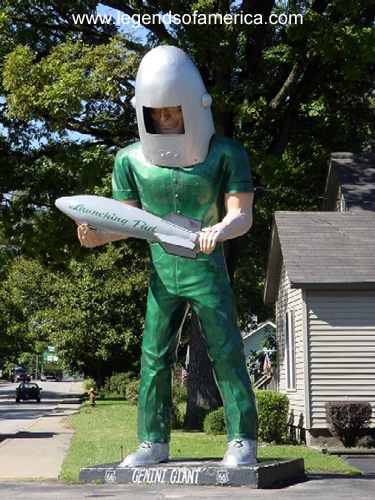
Route 66 was once lined with both categories of giant sized Americana. A few examples survive today, including the Wigwam Motel in Hollbrook, AZ., and an over-sized space man known as the Gemini Giant in Wilmington, IL., but much has been lost.
When President Eisenhower signed the Federal Aid Highway Act of 1956 into law, he helped sound the death knell of roadside attractions in America. The law instituted the federal interstate system, connecting the country in a new way, but bypassing most of the tourist traps near smaller highways that no longer saw a large amount of traffic.
All across the country these irreplaceable pieces of America are in danger or are already gone forever. In California, Las Vegas and the Jersey Shore a number of examples of Googie architecture of the 1940s and 50s, which often used mimetic devices, have been torn down and in most cases replaced with designs of modern and post-modern simplicity or ubiquitous boxes lacking any semblance of style.
Giant sized Indians, cowboys, corn…and the greatest of them all, Paul Bunyan and Babe the Blue Ox towering above the landscape. Actually there were and still are two giant Paul Bunyans in Minnesota, one that talked, in Brainerd and the other, which stood mute, in Bemidji. These roadside attractions represent a quickly disappearing art form that is a link to the best and worst of pre-interstate America—an unbounded desire for the new and weird melded with crass commercialism.
This uniquely American art form that combines art, artifice and advertising on a grand scale can be broken down further into two sub-categories. The first is mimetic architecture, buildings meant to resemble a person animal or object, as in the Brown Derby Restaurant—a building in the shape of, yes you guessed it, a brown derby hat—in Los Angeles. The other category consists of giant sculptures with no utilitarian purpose as in the above-mentioned Paul Bunyans. The common trait of all these works are a sense of the naive that can be compared to the paintings of Grandma Moses, that is, the proportions may not be correct, but the work has undeniable vitality and truthfulness.
I’ve found that the most exotic of man-made wonders have been built in places with a dearth of natural ones. Middle America could perhaps be considered the roadside attraction epicenter for this reason. Miles of corn, wheat or barren moonscape seems a natural setting for a giant bull, T-Rex, or an aqua-blue whale. But in the America of the 1930s, 40s and 50s, anywhere people passed through or vacationed was fair game and competition often pushed the boundaries of the imagination.
Henry Ford, by mass-producing his Model T and thereby lowering the cost of the automobile, helped usher in the era of roadside tourist traps. The entrepreneurial of spirit could now fleece the passing motorist in a way that P.T. Barnum never has the opportunity to do. If you weren’t lucky enough to own the rights to some natural wonder like a cave or scenic vista you could always build something big enough or strange enough to pique the interest of a passing motorist.
Route 66 was once lined with both categories of giant sized Americana. A few examples survive today, including the Wigwam Motel in Hollbrook, AZ., and an over-sized space man known as the Gemini Giant in Wilmington, IL., but much has been lost.
When President Eisenhower signed the Federal Aid Highway Act of 1956 into law, he helped sound the death knell of roadside attractions in America. The law instituted the federal interstate system, connecting the country in a new way, but bypassing most of the tourist traps near smaller highways that no longer saw a large amount of traffic.
All across the country these irreplaceable pieces of America are in danger or are already gone forever. In California, Las Vegas and the Jersey Shore a number of examples of Googie architecture of the 1940s and 50s, which often used mimetic devices, have been torn down and in most cases replaced with designs of modern and post-modern simplicity or ubiquitous boxes lacking any semblance of style.
Subscribe to:
Posts (Atom)


 Posts
Posts